
Welkom bij de SIG High Complexity Buildings
High Complexity Buildings
HIGH COMPLEXITY BUILDINGS
NVBK-DACE SIG High Complexity Buildings (HCB)
Objective of SIG HCB
The objective of SIG HCB, as set out in its charter, is to share and exchange knowledge and experience relating to the construction of complex buildings, with Cost Engineering serving as the connecting factor.
In today's demanding society and (real estate) economy, we are increasingly dealing with complex buildings. This is often because numerous requirements must be met (including sustainability, multifunctionality and flexibility), while space is scarce and therefore expensive. Complexity often arises when multiple functions are accommodated within a building and/or its envelope, each with requirements that are not necessarily compatible. Cost Engineers are expected to provide accurate estimates of investment costs at an early stage, taking into account all aspects and potential technical solutions.
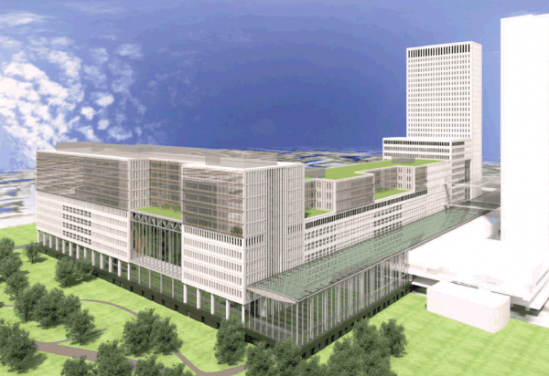
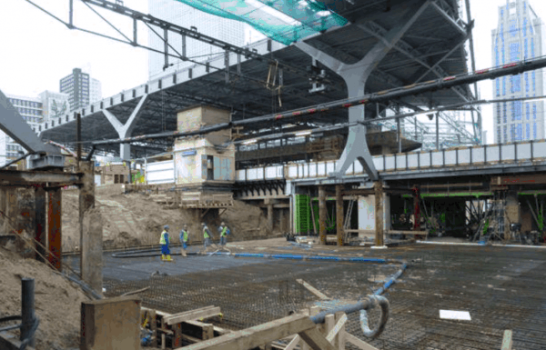
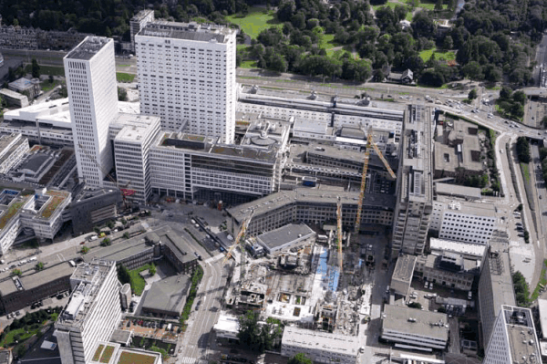
An additional challenge is often the short construction period in a complex environment (such as a railway station, hospital or factory), which must also remain operational during construction ("building while keeping operations running"). The large number of stakeholders involved, including clients, users, facility managers and permitting authorities, can also add to the complexity of the project in terms of scope and project control.
Types of Buildings
We classify the following types of buildings as complex in terms of their functionality and/or construction:
- Supporting buildings at industrial complexes (control rooms, etc.)
- Cleanrooms
- Laboratories and Research & Development centres
- Food production facilities
- Pharmaceutical facilities
- Data centres
- Bunkers (cyclotrons)
- Research centres
- Transport hubs (major railway stations, airports, etc.)
SIG HCB Participants
SIG HCB consists of a cross-section of professionals who are directly involved in the design and construction of complex buildings. Representatives from all stakeholder groups have already joined, although the client side (asset owners and their representatives) is still somewhat underrepresented.
All SIG HCB participants are members of NVBK and/or participants in DACE.
SIG HCB Participants:
Frank Michielen (chair)
Harmen Bunk - ARCADIS Nederland b.v.
Steffen Chang - Twynstra Gudde
Guide van Haalen - BAM Utiliteitsbouw
Rob van de Heiden - BOAG Advies en Management
Marc Hengstmangers (vice-voorzitter) - IGG Bouweconomie
Marieke Kappert-Lankhorst - Kontek
Bernd Karstenberg - BBN adviseurs
Mart van de Leur - ABT b.v.
Wienie van Lierop - BAM Utiliteitsbouw Grote Projecten
Roel Maas - Tebodin
Richard ’s-Gravemade
Jacqueline Schlagwein - Schiphol Group
Sander Stolk - Tebodin
Arie van der Ven - Aronshon Raadgevende Ingenieurs
Niels Vlieg - Schiphol Group
Anton de Vries - Dukers & De Cock
Erik Weldring - Grontmij Nederland b.v.
Simon Woude - Arcadis Nederland b.v.
Working Groups
During the founding meeting on 13 January, three working groups were also established based on an agreed shortlist of topics that SIG HCB will examine in greater detail in the coming period.
The shortlist consists of the following six topics:
- Business case (costs and revenues)
- LCC+ (Life Cycle Costs), including Total Cost of Ownership
- Contract types / co-creation
- Cost benchmarks (including cost estimating) and cost drivers
- Cost control (including the role of the cost consultant)
- Programme of Requirements / Scope
The working groups that will address these topics in the coming period are as follows:
Life Cycle Database: Marc Hengstmangers (Group Leader), Bernd Karstenberg, Erik Weldring, Steffen Chang, Marieke Kappert and Mart van de Leur.
Parametric Analysis with Cost Drivers: Erwin Heinen (Group Leader), Simon Woude, Ron van den Berg, Rob van der Heiden and Jaccqueline Schlagwein.
Collaboration and Co-creation: Winnie van Lierop (Group Leader), Niels Vlieg and Harmen Bunk.
SIG HCB will meet at least four times a year at the premises of one of its participants. Opportunities for cross-fertilisation with other SIGs, including Parametric Analysis, will also be explored.
Establishment of SIG HCB
Following a brainstorming session in June 2014 and a joint DACE–NVBK networking meeting in September 2014, the Special Interest Group High Complexity Buildings officially got off to a flying start on 13 January 2015.
This SIG was established through close cooperation between NVBK and DACE. It is the seventh SIG within DACE.
Primary administrative support for SIG HCB is provided by the NVBK Secretariat. Naturally, you can also contact the DACE Office with any questions about SIG HCB.
DACE and NVBK
To read the report of the joint networking meeting of DACE Cost Engineers and NVBK cost experts held in September 2014, click here.
Contact
Contact details for DACE or NVBK.
Contact details of the Chair of SIG HCB:
Frank Michielen
Email: Frank.Michielen@atosborne.nl
Contact details of the Vice-Chair of SIG HCB:
Marc Hengstmangers
Email: m.hengstmangers@igg.nl
Partners